|
Amplifier
Shocks
|
|
|
Many vintage guitar amps, like early Fender® and Gibson®
models, can give you a ground shock if you simultaneously touch your guitar
strings and another grounded metal device, microphone, or lamp.
A little history of house wiring will explain why this happens.
|
|
Prologue
|
|
In the 1950s - 60s, the power cord of every U.S. appliance had two
wires and a plug with two identical
prongs. And each wall socket had two identical slots, matching the prongs.
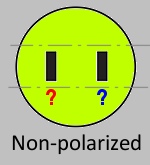
Such plugs and sockets are non-polarized—either
prong can contact either slot by rotating the plug 180°.
This can create a shock hazard because one slot carries the hot
(line) voltage and the other slot is neutral, connecting to
earth at the electrical
service panel.
The "Death Cap"
Ground shocks are often due to a
capacitor connected between the amplifier chassis (audio ground) and one
wire of its power cord.
The purpose of the capacitor is to filter out AC line noise that could
otherwise cause buzzing from your speaker.
Sadly, your guitar strings also connect to audio ground. To
be safe from ground shocks, the so-called "death cap" should connect to the neutral
wire of the power cord, not the hot. But, back then, there was no way
to tell which wire was which.
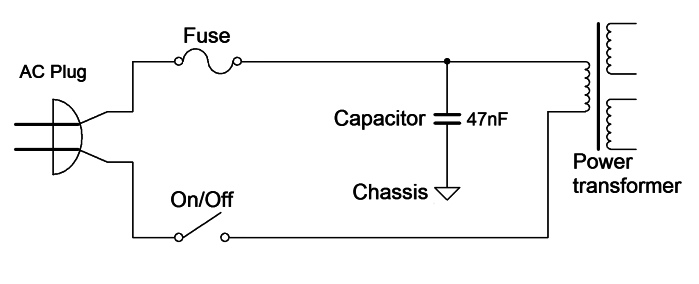
The following schematic shows the AC input circuit of a typical vintage guitar amp.
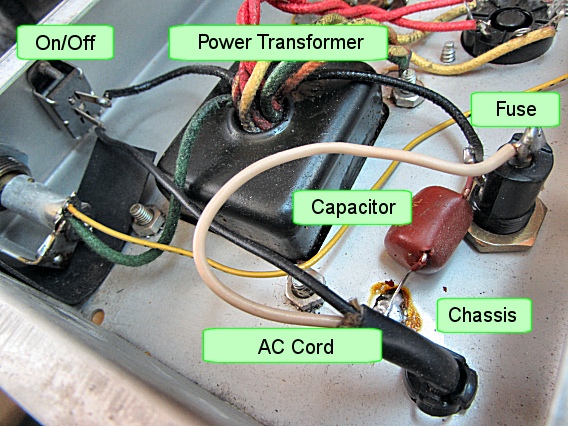
Following that, a photo shows the AC wiring in a Fender Vibro Champ® guitar amp.
Since the AC plug is non-polarized, the "death cap" could go to either
the hot or the neutral voltage depending on how the AC plug is inserted in the wall socket.
|
 Typical AC Circuit
 Vibro Champ® Wiring
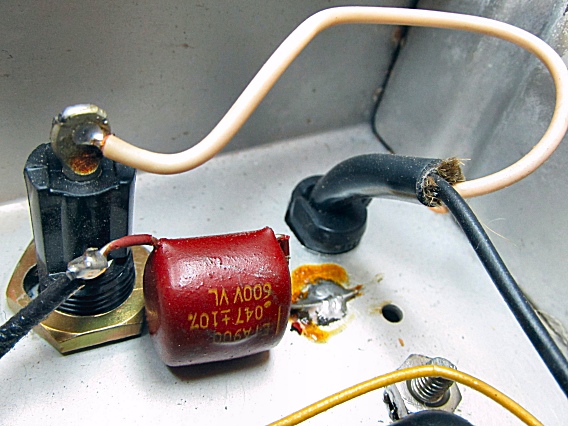 'Death Cap'
|
|
|
Polarized Plugs
|
|
The first and maybe only thing you need to do to eliminate ground shocks
is to replace your amp's non-polarized wall plug with a
polarized plug.
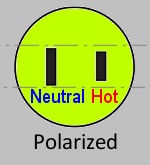
Polarized plugs and sockets have one prong or slot that's
wider than the other, so they connect together in just one way.
The narrow slot carries the hot voltage,
the wide slot is neutral.
Before you put a polarized wall plug on your amp's power cord, you must
know which wire to connect to the wide prong and which to the narrow.
Our repair story Fender Vibro Champ Shocks
shows you how to determine the safe wiring polarity.
|
|
"Death Cap" Removal
|
|
If a polarized AC plug doesn't cure your shock hazard, eliminating the "death
cap" (if present) is your next step. To remove the capacitor, simply cut its two wire leads at the points
where they're soldered.
The schematic below shows the AC circuit with a new, polarized AC plug
and with no "death cap".
|
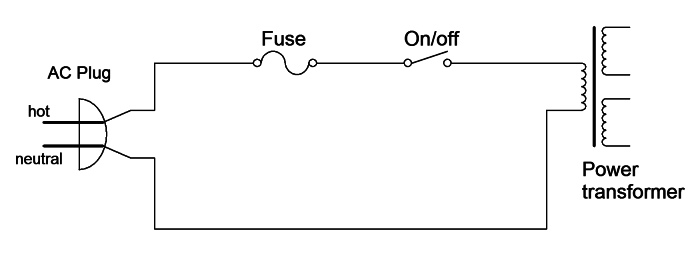 Two-prong, polarized AC plug — No 'death
cap'
Two-prong, polarized AC plug — No 'death
cap'
|
WIRING NOTES:
- By convention, the black wire of a power cord is hot and the white
wire is neutral.
So, the black wire normally goes to the narrow prong and the
white wire to the wide prong.
- The black (hot) wire should go to the amp's On/Off switch.
- Either wire may go to the fuse holder but the hot is preferred.
For safety, connect the hot to the holder terminal farthest from the fuse cap.
- If the primary coil of the power transformer has one black wire and one white
wire, connect its black wire to the hot.
Otherwise, connect either transformer wire to the hot.
|
|
Ground Switches
|
|
Some vintage amps have a two-position Ground Switch,
letting you pick which AC prong connects to the "death cap". Flipping the
ground switch is equivalent to rotating the AC plug:
|
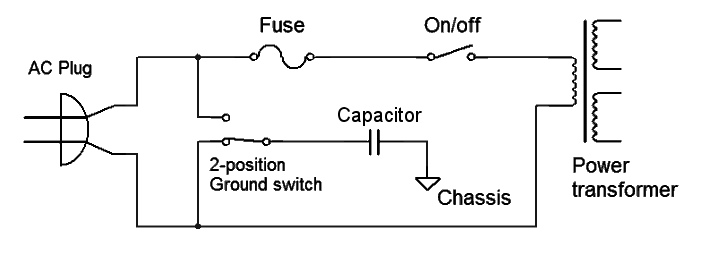 Non-polarized AC plug — Two-position ground switch
|
Other vintage amps have an On/Off switch with two 'On' positions that accomplish the same function.
Ground switches don't remove the risk of shock—one setting of the
switch connects your guitar strings to a hot "death cap".
The setting with the least amount of buzz is
usually the safe position but sometimes there's no audible difference
to guide you.
On the bright side, if you do get a shock, flipping the ground switch
should stop them, until the AC plug gets reversed.
Three Positions
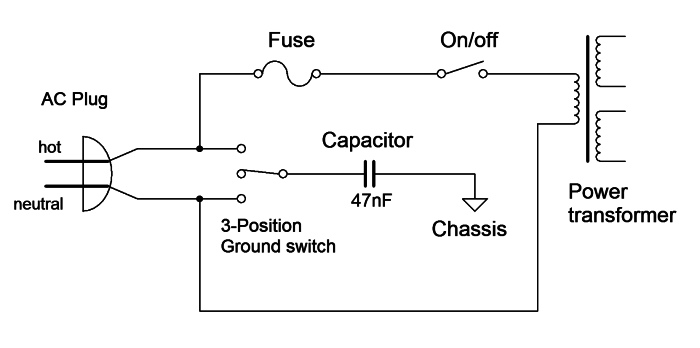
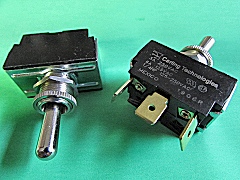
You can also install a three-position ground switch whose
center position disconnects the "death cap" entirely. When the switch is in the center position, you know you're safe.
And you can still use the capacitor if it helps reduce amp buzz.
Just take extra precaution when the ground switch isn't centered.
|
 Polarized AC plug — Three-position ground switch
|
|
|
Grounded Wall Plugs
|
|
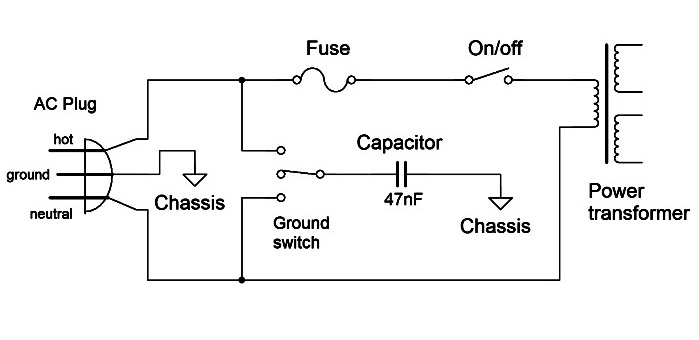
In 1969, Underwriters Laboratories mandated 3-wire, grounded plugs on
all major appliances. The plugs have a third, round prong connecting directly to the metal chassis of the appliance.
The next diagram shows how to connect a 3-wire AC cord to a vintage
guitar amp. In addition to the hot and neutral wires, the cord
has a green wire that should be soldered or screwed to the amplifier chassis.
|
 Grounded AC plug — Three-position ground
switch
Grounded AC plug — Three-position ground
switch
|
In 1969, about half of the wall sockets in U.S. homes accepted
three-prong plugs. However, most of those sockets didn't have
a third wire going straight to earth. And many sockets still don't.
A third wire to earth can provide some safety in the event of an
electrical surge but it doesn't usually provide any more ground-shock
protection than a properly polarized two-prong plug.
|
|
Available In Our Store
|
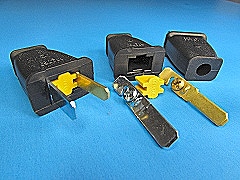
Two-Prong,
Polarized
Wall Plug
|
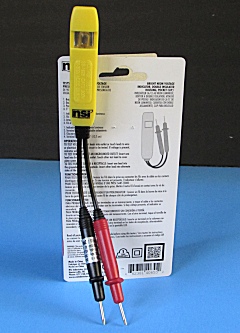
Neon
Voltage Tester
|
Three-Position
Ground Switch
|
®See trademark owners
HERE.
|
|

