FAQ INDEX
Speaker Loads and Wiring
LOADS
Guitar and P.A. amps are geared to drive a certain load impedance,
measured in ohms. "Load impedance" is the resistance that the speakers put up to the flow of
electric current.
The lower the resistance, the more juice your amp must pump out.
So a lower load impedance is a bigger load for the amp. And
a higher load impedance is a smaller load for the amp.
OHMS
A single, raw speaker has an impedance of either 4, 8, or 16 ohms.
In cabinets, speakers of equal
impedance are wired together to create a combined total load, whose
impedance can be different than the raw speakers' value. (Schematics
are
below.)
If ohms aren't marked on a speaker or a cabinet, you can determine it with an ohmmeter.
Round up the meter's reading to 4, 8, or 16 ohms.
Some amps have an impedance-selection switch, or various speaker jacks, to
match various speaker loads. Changing speaker loads is one of the easiest
and most dramatic ways to change the sound of a guitar amp.
IMPEDANCE MATCHING
It's important that the speaker load matches the amplifier.
If the speaker impedance is too high, the amp might sound weak or dull.
If the speaker impedance is too low, the amp might sound
fantastic but eventually blow up. Amps are often labeled with
the minimum ohms you can safely connect.
If your amp uses power tubes, always have speakers connected when the amp
is turned on. Without a load, the amp's output transformer can
easily be damaged,
especially if you're playing through it.
CABINET WIRING - TWO SPEAKERS
There are exactly two ways to connect two speakers together.
One is "series"
wiring and the other is "parallel".
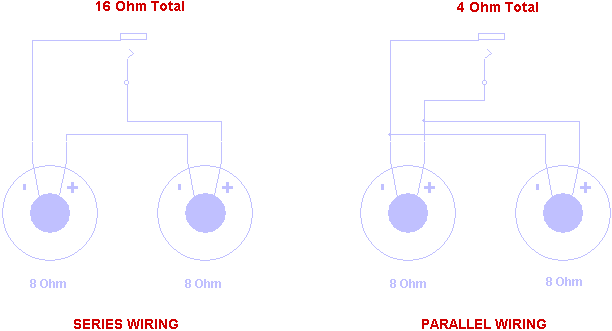
Series wiring results in double the impedance of one speaker.
Parallel wiring results in half the impedance of one speaker.
This schematic shows how to wire two 8-ohm speakers into either a 16-ohm
or a 4-ohm cab.
To make an 8-ohm cab, use two 4-ohm speakers in series, or two
16-ohm speakers in parallel.
CABINET WIRING - FOUR SPEAKERS
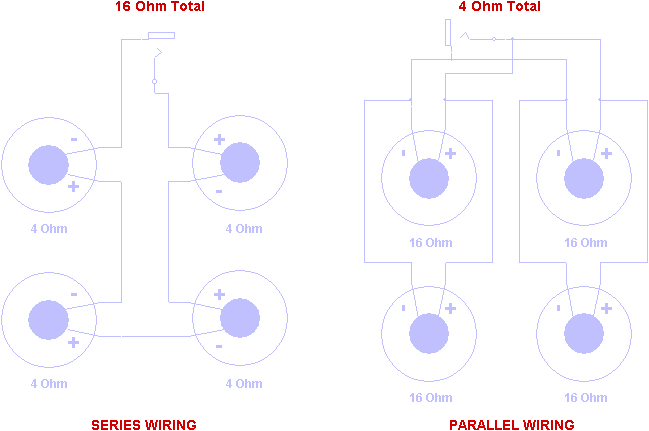
Wiring four speakers in series quadruples the
impedance of one speaker. Wiring them in parallel quarters the impedance of
one
speaker.
CABINET WIRING - SERIES-PARALLEL
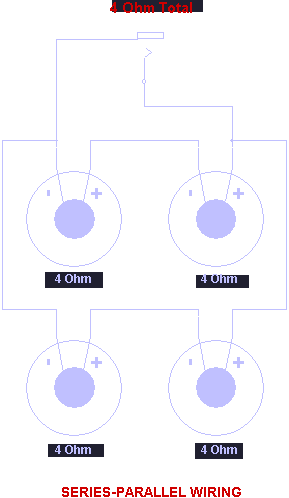
A third way to wire four speakers is called "series-parallel". In this method,
a pair of series-wired speakers is wired in parallel to a second
pair of series-wired
speakers.
The total impedance is equal to the impedance of one speaker. This
schematic shows how to wire four 4-ohm speakers into a 4-ohm cab. Do
the same thing with 16-ohm speakers to get the classic Marshall cab.
(To make an 8-ohm cab, wire four 8-ohm speakers in series-parallel.)
CABINET WIRING - MONO/STEREO
This schematic shows the wiring of a Marshall® 2x12"
speaker cab with a Mono/Stereo switch and two input jacks.
With the Mono/Stereo switch set to Mono, you get the two 8-ohm
speakers either in series (16 ohms) or in parallel (4 ohms) depending on
which input jack you use.
With the switch set to
Stereo, each jack connects to its own 8-ohm speaker. In
this mode, the cabinet can be used with a stereo power amp and separate
left and right signals.
To make a four-speaker Mono/Stereo cabinet, replace each 8-ohm speaker with two 4-ohm speakers wired in series or
with two 16-ohm speakers wired
in parallel.
Additional Resources:
Marshall® is a registered trademark of
Marshall® Amplification plc.
TOP OF PAGE
|
FAQ INDEX